

Change and Cost Management on Infrastructure Projects
In the lifecycle of major infrastructure projects, two truths remain constant: change is inevitable, and cost is the ultimate yardstick of success. As sure as these truths may be, their relationship with each other is highly volatile - a major issue when you're talking about multi-billion dollar projects. A single unmanaged change in a bridge's structural specification can trigger a financial ripple effect that threatens the entire project's viability.
Effective delivery isn't about preventing change, however - it's about managing it in conjunction with cost. When these two disciplines are siloed, uncertainty rears its ugly head. When they're integrated, though, they provide the "financial conscience" needed to deliver some degree of certainty in an unpredictable environment. We're going to take a look at what this process involves, the risks that infrastructure projects can sidestep as a result and how companies like PDAS can help.
Key takeaways
- The cost of implementing change increases exponentially as a project progresses through its Stage-Gate phases. Identifying and resolving changes during "Feasibility" is significantly cheaper than during "Construction".
- Effective cost management requires a robust Performance Measurement Baseline (PMB). This serves as the "source of truth" to measure the impact of every proposed deviation in scope or schedule.
- All potential changes must undergo a formal Integrated Change Control (ICC) process to quantify financial impact, explore cheaper alternatives, and ensure governance is maintained through proper financial delegation.
- Successful projects move beyond static reporting to use Earned Value Management (EVM) and trend analysis. This allows leaders to identify cost overruns early and protect contingency funds before they are exhausted.
The Dynamics of Infrastructure Cost Escalation
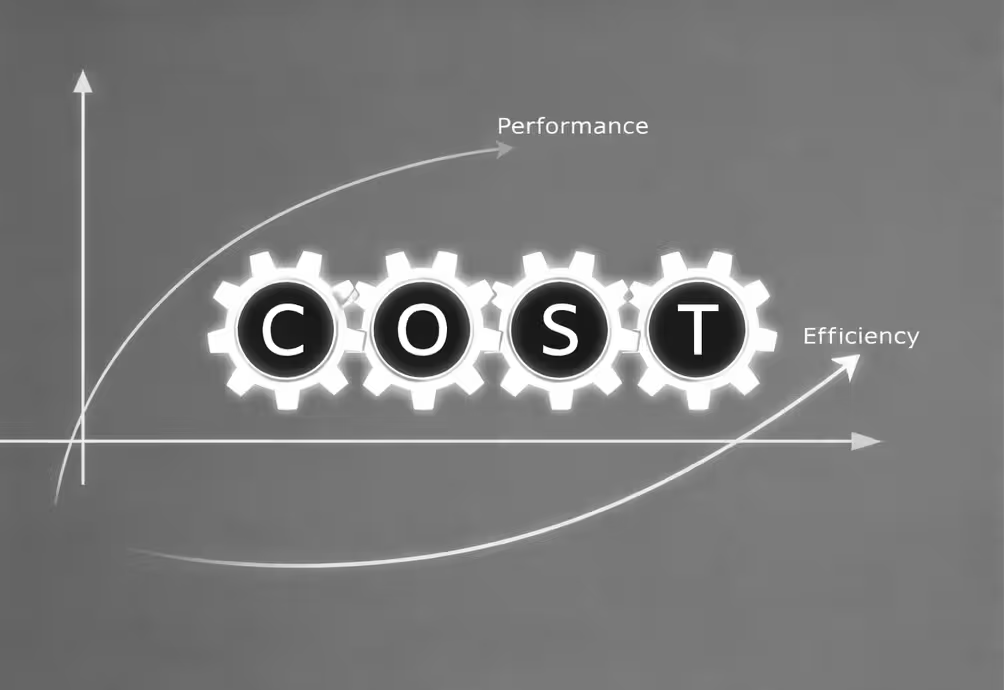
Infrastructure projects are particularly sensitive to change due to their physicality and sequence. Unlike software, for instance, where code can be refactored relatively easily, changing a structural foundation once the concrete is poured is prohibitively expensive.
Because infrastructure is inherently path-dependent, a deviation in one area rarely remains isolated. Instead, it triggers a chain reaction across the project's financial and contractual framework. The value erosion this causes typically arrives through three primary channels:
1. The Multiplier Effect of Late-Stage Changes
The cost of implementing a change increases exponentially as a project moves through the Stage-Gate process. A change identified during the "Ideation" or "Feasibility" stage may cost only the time of an engineer's revision. That same change during "Construction" involves demolition, material waste, re-procurement, and profound schedule delays.
2. Scope Creep and "Gold Plating"
Without a rigorous change management framework, projects often suffer from incremental scope creep - small, seemingly insignificant additions that collectively bloat the budget. Similarly, "gold plating" - adding features or quality levels beyond what is required by the business case - diverts capital away from key path activities.
3. Contractual and Procurement Friction
In the EPC environment, every change is a potential dispute. Frequent variations lead to "claims cultures", where contractors and owners spend more time litigating change orders than executing work. This friction can add a significant "hidden cost" of legal fees and administrative overhead.
Additional Drivers of Change and Cost
Beyond project controls and formal change processes, several upstream and external factors can influence cost outcomes on infrastructure projects:
Stakeholder, Regulatory and Environmental Inputs
Planning approvals, community feedback, political shifts and utility coordination often introduce unavoidable changes. These external forces require early engagement and active management to avoid late rework.
Interface and Integration Management
Multi-package programmes depend on tight coordination. Misaligned assumptions between designers or contractors commonly result in rework and cost escalation.
Schedule and Productivity Performance
Delays, access issues, weather impacts and labour productivity shortfalls often manifest as cost changes. Protecting schedule integrity is, therefore, central to protecting the budget.
Data Quality and Digital Integration
Modern delivery relies on BIM, CDEs and integrated cost-schedule systems. Poor data quality leaves you vulnerable to erroneous change analysis and forecasting accuracy.
Value Management
Change should be evaluated not only for cost but for long-term value. Incorporating value engineering and whole-of-life considerations ensures changes support the business case, not inflate it.
Integrating Change and Cost: The Control Framework
To maintain financial integrity, organisations need to move beyond reactive accounting and towards proactive cost engineering. This requires a framework where every change is evaluated through a cost-benefit lens before it's approved.
Baseline Integrity and the Performance Measurement Baseline (PMB)
You can't properly manage what you haven't properly defined. Successful cost management begins with a thorough Performance Measurement Baseline (PMB) - a time-phased budget that integrates scope, schedule and cost. This baseline serves as the source of truth against which all proposed changes are measured.
The Integrated Change Control (ICC) Process
Every proposed change, whether technical, regulatory or operational, must pass through a formal Integrated Change Control process. ICC ensures that:
- Impact is quantified: The effect on the total out-turn cost (TOC) and the project schedule is fully understood.
- Alternatives are explored: Can the requirement be met through a less expensive modification?
- Governance is maintained: Approval is granted only by those with the appropriate financial delegation, maintaining strategic alignment.
Trend Analysis and Forecasting
Static cost reporting (looking at what has already been spent) isn't enough. High-performing projects use Earned Value Management (EVM) and trend analysis to look forward. By identifying cost trends early, such as a consistent 5% overage in bulk material costs, project leaders can implement corrective measures before the contingency fund is exhausted.
The Role of Contingency and Risk Management
Cost management is basically an exercise in risk management. No budget is perfect, which is why capital projects use two types of financial buffers:
Contingency: Funds held for "known-unknowns" - risks that have been identified but whose exact timing or impact is uncertain.
Management Reserve: Funds held for "unknown-unknowns" - unforeseen strategic shifts or force majeure events.
That said, the key to success is not just having these funds, but managing them through the Stage-Gate process. As a project progresses and technical uncertainty decreases, the contingency should be "retired" or re-allocated. If the contingency is being consumed faster than the project is progressing, it's a major indicator of systemic change management failure.
How PDAS Can Help
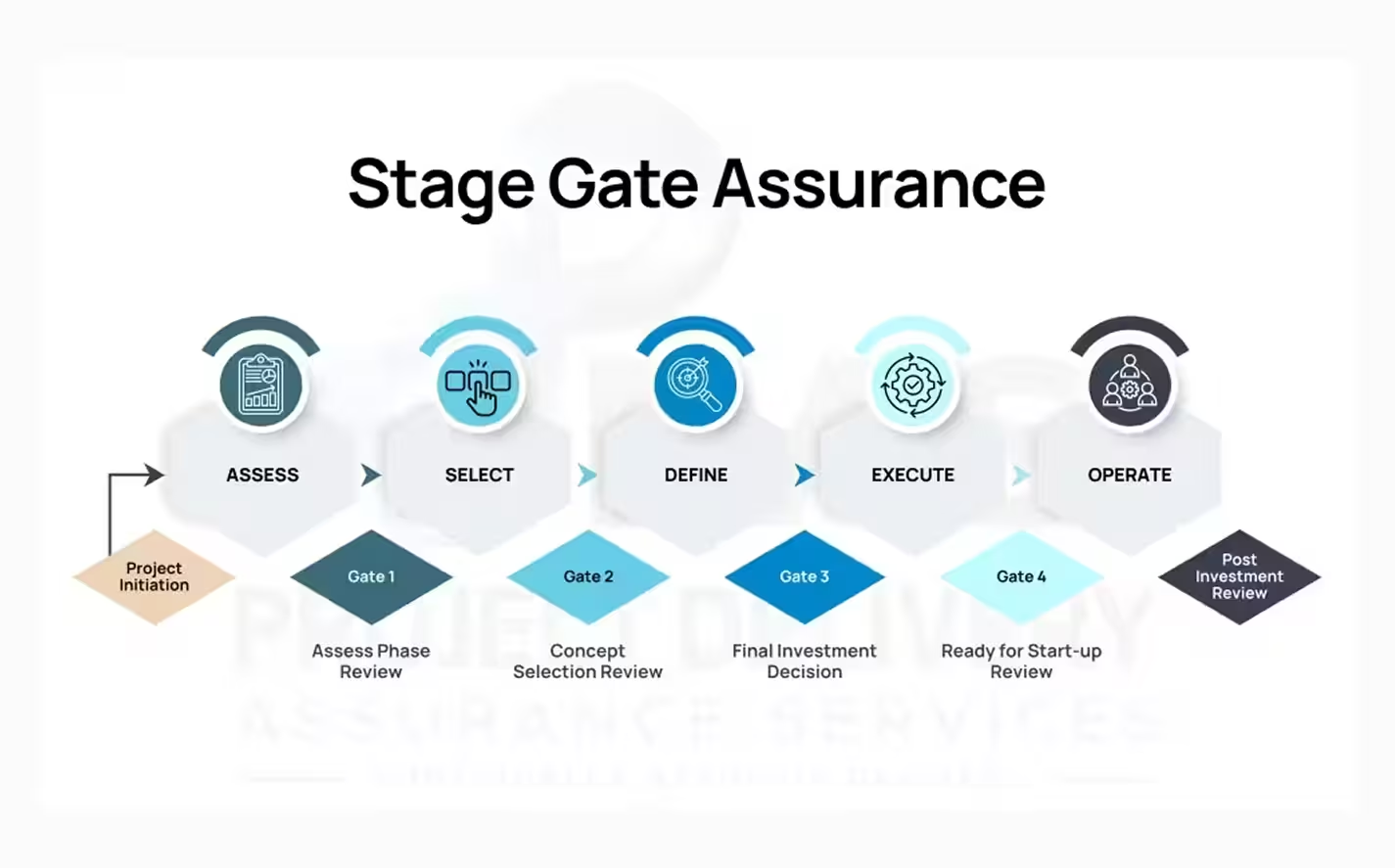
At PDAS, we offer an expert perspective on the technical reality of change and cost control. Having successfully delivered some of the world's largest infrastructure projects, we understand better than most that a spreadsheet is only as good as the data and the discipline behind it.
Integrating our risk-based assurance within your existing Stage-Gate governance, we provide your board and steering committee with objective clarity about your project's financial health. With PDAS, you gain the project intelligence needed to control change, protect your contingency and deliver capital outcomes with absolute financial certainty.
Get started with PDAS and bring the uncertainties in your infrastructure project under expert control.