

Key Takeaways
- EY's Top 10 Business Risks and Opportunities for Mining and Metals 2026 ranks operational complexity as the number one risk facing the sector, up from fourth in 2025. Maintenance discipline is named as a specific area where short-term thinking is eroding long-term performance.
- ARC Advisory Group's analysis of failure pattern data shows that only 18 percent of industrial assets exhibit an age-related failure pattern. The remaining 82 percent fail randomly, which means time-based preventive maintenance is the wrong tool for most of the asset base.
- McKinsey's research finds predictive maintenance typically reduces machine downtime by 30 to 50 percent and extends equipment life by 20 to 40 percent. The same firm also documents that lower-maturity programmes deliver only around 10 percent of the benefits of fully scaled deployments.
- PwC and Mainnovation's survey of 280 industrial companies found only 11 percent had reached the highest level of predictive maintenance maturity. Two-thirds were stuck at the bottom of the maturity ladder. The bottleneck is governance, not technology.
- The biggest predictive maintenance disclosures from operators such as Saudi Aramco at Khurais, Equinor's Bergen Operations Centre, and Rio Tinto's Mine of the Future all share a common feature: the savings came from the operating model around the technology, not the technology itself.
Maintenance strategy has become a Board-level question. The EY Top 10 Business Risks and Opportunities for Mining and Metals 2026 moved operational complexity from fourth place to first place in a single year. The report is direct about why: maintenance discipline is slipping across the sector, with preventative work being sacrificed for short-term cost relief, and the consequences are showing up in production attainment, asset reliability, and unit cost performance.
Against this backdrop, the question of which maintenance philosophy delivers the best return on capital deserves a more rigorous answer than the one most operators rely on. The data on reactive, preventive, and predictive maintenance has been published, peer-reviewed, and benchmarked across thousands of facilities. What it shows is consistent. What most organisations do with that evidence is less consistent than the data would justify.
This article sets out the numbers: where reactive maintenance still makes commercial sense, where it does not, what predictive maintenance has actually delivered in the Energy, Minerals and Resources (EMR) sector, and why the governance discipline around the technology is what determines whether the investment pays back.
What Do the Three Maintenance Strategies Actually Cost?
The three dominant maintenance philosophies operate on different cost curves. Reactive or run-to-failure maintenance is the lowest-cost strategy until something breaks. Preventive maintenance applies time-based or runtime-based interventions to reduce the probability of failure. Predictive or condition-based maintenance uses sensor data and analytics to trigger interventions when a specific asset shows early indicators of degradation.
The US Department of Energy's Operations and Maintenance Best Practices Guide remains the canonical reference for the cost differentials between the three. A functional preventive programme typically costs 12 to 18 percent less than a reactive programme on the same asset base. A functional predictive programme typically costs 8 to 12 percent less again than preventive, and 30 to 40 percent less than reactive when measured on a total cost of ownership basis. McKinsey's industry research finds predictive maintenance typically reduces downtime by 30 to 50 percent and increases equipment life by 20 to 40 percent.
The unplanned downtime cost data is more sobering. ARC Advisory Group estimates that unplanned downtime costs the global process industries close to one trillion US dollars per year, with unplanned downtime costing approximately ten times planned downtime in process plants. Kimberlite's offshore reliability study found the average offshore platform loses 27 days a year to unplanned downtime at an average cost of 38 million US dollars per year. McKinsey's refinery research puts the reliability gap between median and top-quartile US refiners at 20 to 50 million US dollars per year in lost profit opportunity for a single mid-sized facility.
These numbers do not, by themselves, settle the strategy question. They demonstrate that the cost of getting maintenance philosophy wrong is large and consistent. The harder question is which assets justify which strategy.
When Is Reactive Maintenance the Rational Choice?
Reactive maintenance is not always the wrong answer. For low-criticality assets with redundancy built into the system, low replacement cost, and no safety or environmental consequence on failure, run-to-failure can be the most economically rational strategy. The cost of monitoring and intervention exceeds the cost of replacement on failure.
The error most Energy, Minerals and Resources (EMR) operators make is not in choosing reactive maintenance for these assets. It is in defaulting to reactive maintenance for assets that should be on a different strategy because the criticality assessment was never done, or the criticality framework was approved but not consistently applied at site level. The NIST research on maintenance mix found the top quartile of reactive-reliant facilities had 3.3 times more downtime, 16 times more defects, and 2.4 times more lost sales due to delays than facilities that had implemented a structured strategy across the asset base.
The governance question is not whether reactive maintenance has a place. It is whether the boundary between assets that should be on reactive strategy and assets that should not has been drawn deliberately, documented, and audited.
Why Time-Based Preventive Maintenance Is Often the Wrong Default
Most EMR operators have a preventive maintenance programme. Many use it as the dominant maintenance philosophy across the asset base. The evidence suggests this is over-calibrated.
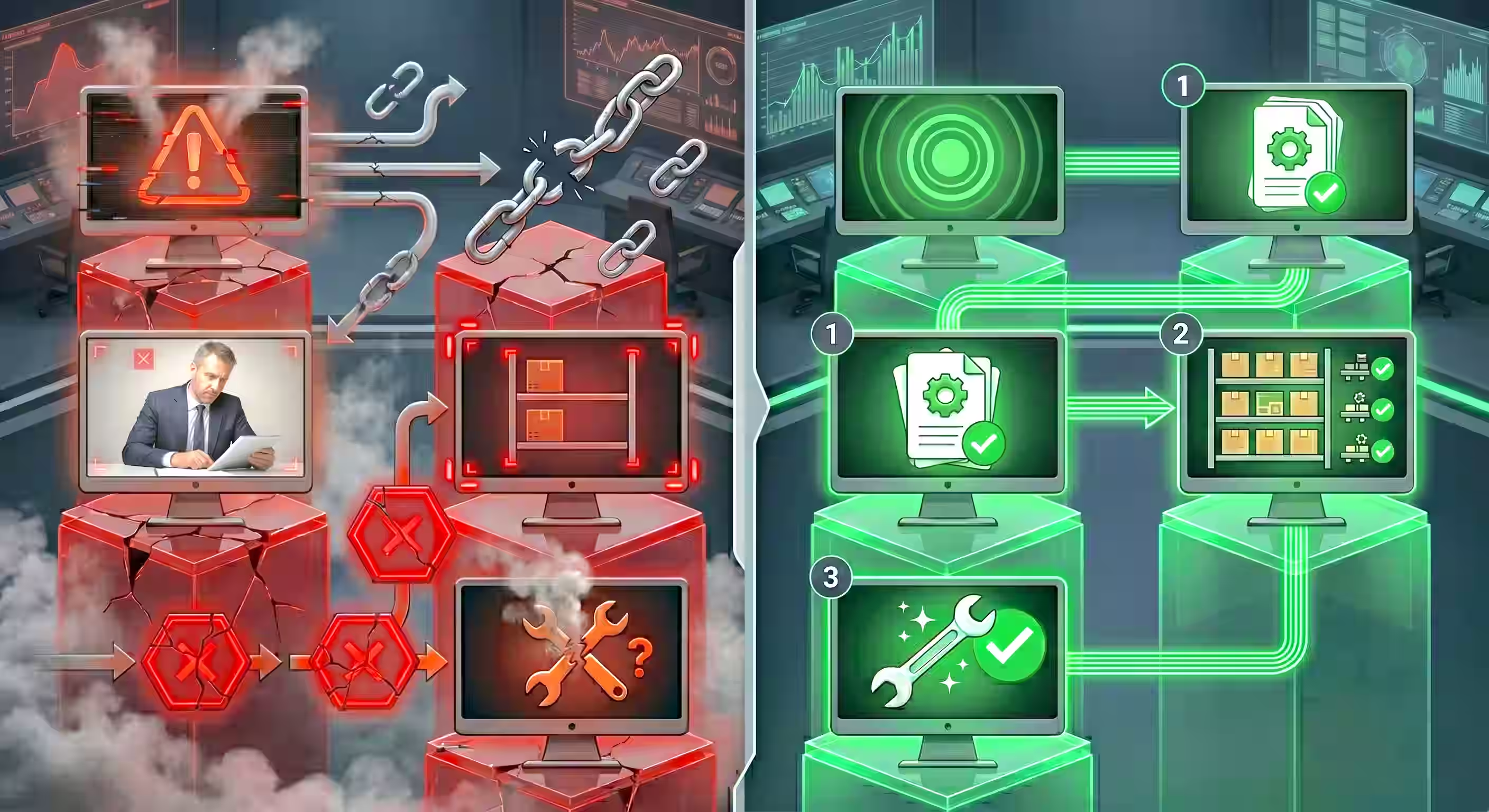
ARC Advisory Group's analysis of four asset reliability studies found that only 18 percent of industrial assets exhibit an age-related failure pattern appropriate for time-based preventive maintenance. The remaining 82 percent fail in patterns that are random with respect to operating hours: infant mortality, random distribution, or specific mode-driven degradation. For these assets, scheduled overhaul on a calendar interval does not reduce the failure rate. It introduces unnecessary intervention cost and, in some cases, increases failure risk by re-introducing infant mortality through the disturbance of stable systems.
This is the empirical foundation underneath the predictive maintenance case. It is not that preventive maintenance is wrong. It is that preventive maintenance is the right strategy for a smaller share of the asset base than most operators apply it to. The economically rational alternative for most assets is condition-based intervention triggered by observed degradation, not calendar-based intervention applied independently of asset condition.
What Predictive Maintenance Has Actually Delivered in the EMR Sector
The vendor case studies on predictive maintenance are abundant. The credible operator disclosures are fewer, but they tell a consistent story.
Saudi Aramco's Khurais Industry 4.0 deployment, recognised by the World Economic Forum's Global Lighthouse Network, reported an 18 percent reduction in power consumption, a 30 percent reduction in maintenance costs, a 40 percent reduction in inspection times, a 50 percent improvement in reliability, and a doubling of operational response times. At Abqaiq, Aramco reported a 20 percent reduction in unplanned maintenance and a 3.8 percent reduction in greenhouse gas emissions.
Equinor's Integrated Operations Centre in Bergen was projected by Equinor to deliver an additional total annual value creation of around 10 billion Norwegian kroner before tax over a ten-year horizon, with the Geo-Operations function alone expected to save 270 million Norwegian kroner per year. Rio Tinto's Mine of the Future programme, supported by autonomous haulage and predictive analytics, was reported to be on a pathway to reduce maintenance costs by approximately 200 million US dollars per year over a three-year period, with autonomous haul trucks operating around 700 hours more per year per truck and 15 percent lower load and haul unit costs.
The EY 2026 mining risks report cites a specific disclosure that is more revealing than any of the headline numbers. Albian Sands extended the operational life of its 400-tonne haul trucks from 80,000 hours to 170,000 hours through a proprietary maintenance approach. That is not a maintenance cost saving in the conventional sense. It is a step change in the capital productivity of the asset itself.
What these disclosures share is not a particular technology stack. It is a deliberate decision to redesign the operating model around the technology, not to deploy the technology and hope the operating model would adapt.
Why Most Predictive Maintenance Programmes Underdeliver
The PwC and Mainnovation survey of 280 industrial companies in Belgium, Germany, and the Netherlands found that only 11 percent had reached the highest level of predictive maintenance maturity. Two-thirds were stuck at the lowest two levels. McKinsey's research finds that lower-maturity systems deliver only around 10 percent of the benefits of fully scaled systems, and identifies change management as the single most critical success factor.
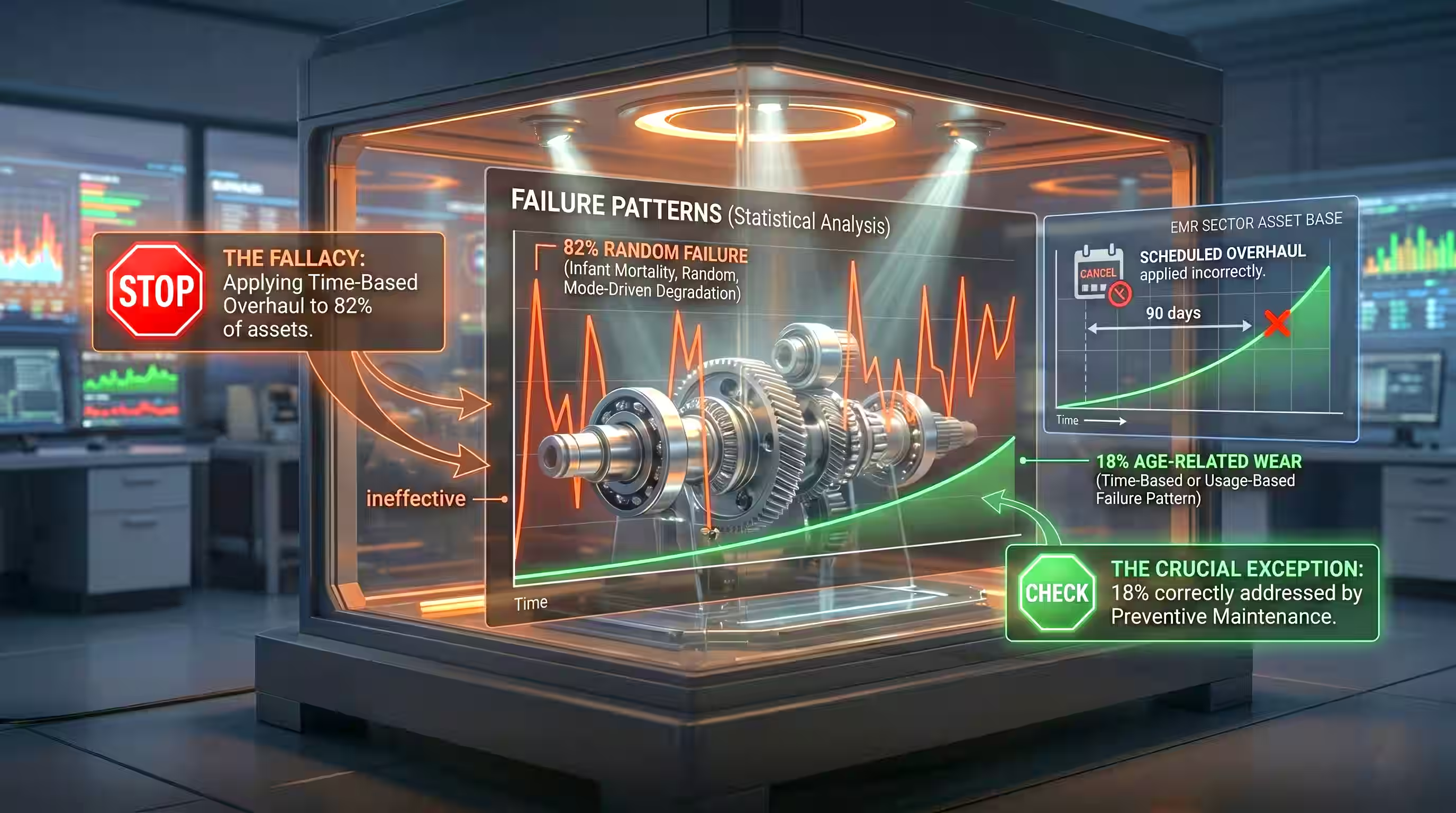
The failure modes are well-documented and consistent across sectors:
- Data quality and integration. Predictive models are only as good as the sensor data, equipment hierarchy, and failure history they are trained on. Many operators discover, after the platform is procured, that the underlying data is too sparse, inconsistent, or poorly tagged to support the analytics.
- Workflow integration. A predictive alert has no value if the work management system, supply chain, and maintenance team cannot convert it into a planned intervention within the window the algorithm has identified.
- False positives. McKinsey's worked example from the chemicals sector shows a 10 percent false-positive rate generating around 1,000 unnecessary interventions per year and wiping out the programme's net savings. Precision and recall metrics matter more than the headline accuracy figures vendors typically report.
- Asset criticality framework. Predictive maintenance is economically justified for high-criticality, high-downtime-cost assets. Deploying it across the asset base regardless of criticality consumes capital and analyst capacity that should be focused where the return is highest.
- Change management at the front line. Maintenance technicians, supervisors, and planners need to trust the algorithm before they will act on it. That trust is built through deliberate workflow redesign, not through dashboards.
None of these failure modes is a technology failure. Each is a governance and operating model failure that the technology cannot fix on its own.
The Governance Question Boards Should Be Asking
The headline numbers on predictive maintenance are real. The cost reduction range is real. The reliability uplift is real. The capital productivity gains at Khurais, in Equinor's offshore operations, and across Rio Tinto's autonomous fleet are real. None of those outcomes was achieved by the operators that bought the same technology and stopped at deployment.
The question that determines whether maintenance strategy creates or destroys value is not which platform to buy. It is whether the organisation has the governance discipline to:
- Apply a documented asset criticality framework consistently across the portfolio, so that each asset is on the maintenance strategy that the criticality and failure-mode evidence justifies.
- Verify, independently, that the data underpinning predictive models meets the quality standard the analytics require, before the platform is deployed at scale.
- Redesign the maintenance work management process before commissioning the technology, so that predictive alerts can actually be converted into planned interventions within the window the algorithm has identified.
- Hold maintenance and reliability performance accountable through metrics that distinguish between activity (work orders closed) and outcome (asset availability, unplanned downtime, mean time between failures).
- Treat the integration with operational technology as a governance question with Board oversight, not a procurement question delegated to operations.
This is the same governance discipline that determines whether operational technology investment delivers a return in the EMR sector more broadly. It is the same governance discipline that operational audits in the energy sector are increasingly expected to validate. And it is the same governance discipline that distinguishes portfolio KPIs that drive better decisions from those that simply report what already happened.
Maintenance philosophy is not a tactical decision delegated to the maintenance function. The numbers are too large, the asset productivity implications too direct, and the governance failure modes too consistent. The operators that get this right will widen the cost and reliability gap with the rest of the sector. The ones that defer the question, or hand it to the technology vendors to answer, will pay for it twice: once in the avoidable failure events and once in the predictive maintenance investments that did not pay back.
-----
PDAS provides independent governance and assurance for capital projects and operational excellence programmes in the Energy, Minerals and Resources sector. We work with Boards, executive teams, and operational leaders to validate that maintenance strategy, asset performance management, and operational technology investment translate into the value the business case promised.