
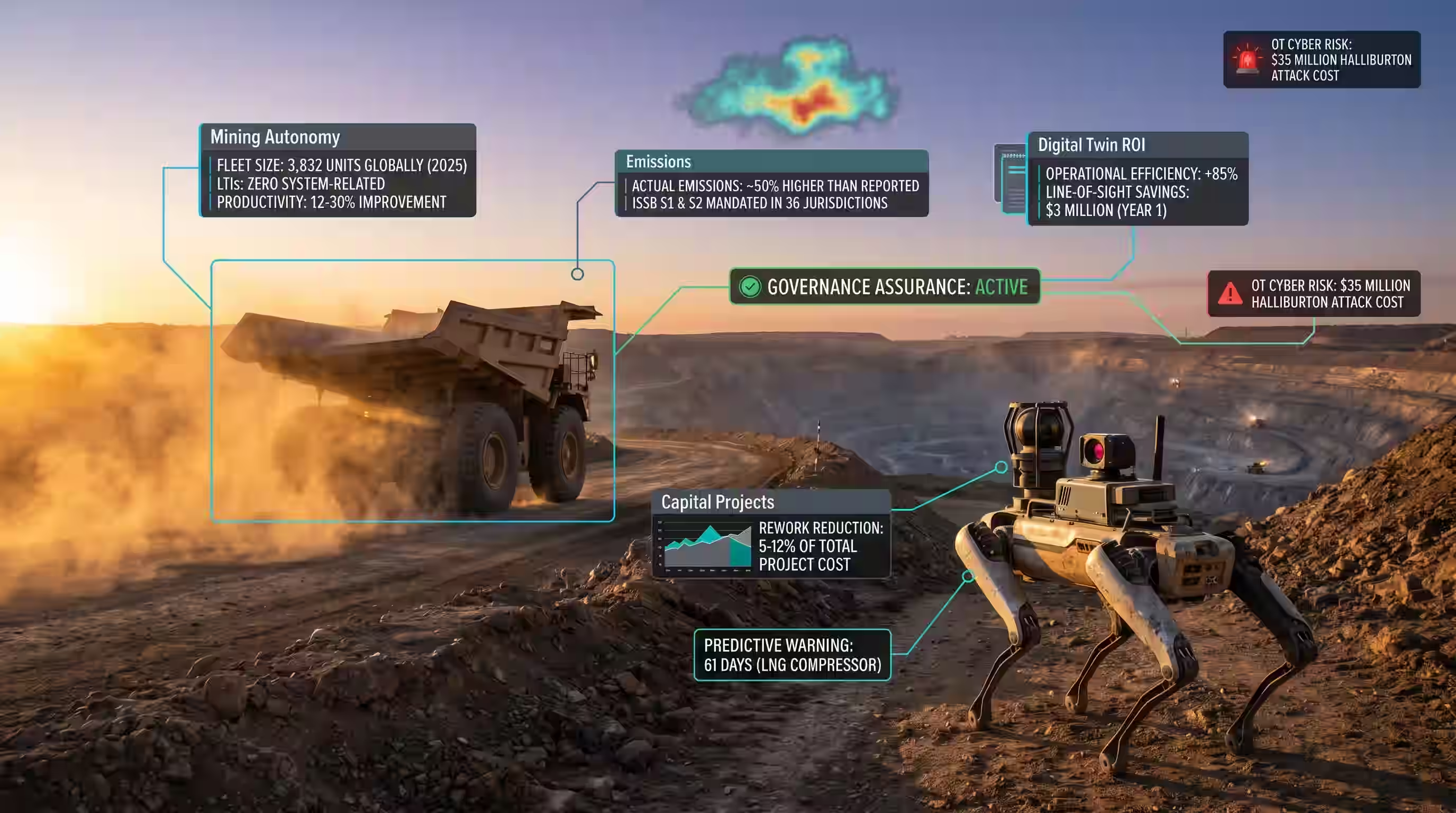
The Energy, Minerals and Resources sector is deploying operational technology at a scale that would have seemed improbable five years ago. Three converging pressures are driving investment: aging infrastructure - average US industrial fixed assets are now 24 years old, the oldest in nearly 70 years - an escalating cyber threat landscape targeting industrial control systems, and tightening emissions regulations across every major jurisdiction.
The more significant shift, however, is evidenced by ROI. Digital twins, AI-driven maintenance platforms, autonomous fleets, and emissions monitoring tools are no longer returning pilot-stage results. They are generating documented, board-level returns at Shell, Rio Tinto, TotalEnergies, and Fortescue. The gap between operators deploying these tools with proper governance frameworks and those deploying them without is now measurable in margin, schedule, and regulatory standing.
This guide covers the leading platforms across six operational technology categories, with named operators, verified deployments, and sourced outcomes. It also addresses, for each category, what governance and assurance requirements the technology creates - because the most persistent failure mode is not the tool itself, but the absence of frameworks to verify it delivers as promised.
Key Takeaways
- Industrial digital twins have matured from pilot projects into enterprise investments generating documented returns within the first year - Shell's Kognitwin deployment at Nyhamna identified line-of-sight savings of $3 million in operating costs in year one.
- AI-driven predictive maintenance platforms are providing advance warning of critical failures measured in weeks, not hours - AspenTech Mtell has documented up to 61 days' advance notice of LNG compressor failures worth $40 million+ per occurrence.
- OT cybersecurity is now a board-level financial risk. Halliburton's 2024 ransomware attack cost $35 million, and ransomware groups targeting industrial operators surged 87% in the same year.
- Common data environments, when properly governed, directly reduce the rework costs that account for 5-12% of total installed project cost on capital projects.
- Satellite-based methane monitoring has revealed that actual emissions are approximately 50% higher than reported inventories, fundamentally changing the regulatory and reputational risk calculus.
- Autonomous mining fleets have logged zero system-related lost-time injuries across their entire operational histories, while delivering 12-30% productivity improvements over manned equivalents.
How Are Industrial Digital Twins Creating Operational Value?
The industrial digital twin has evolved considerably from a 3D visualisation tool into a live operational system connecting engineering data, process performance, and maintenance status in a single environment. The oil and gas digital twin market reached $1.2 billion in 2024 and is growing at an 11.2% CAGR, according to Global Market Insights. Nearly 90% of surveyed mining organisations are now using, implementing, or piloting digital twins, according to Bentley Systems research.
In oil and gas, Kongsberg Digital's Kognitwin is Shell's primary platform for operations optimisation. At Shell's Nyhamna gas processing facility in Norway, the first year of deployment generated use cases with line-of-sight to $3 million in annual operating cost reductions, with 85% of users reporting improved operational efficiency. BP awarded Kongsberg ecosystem partner Aize a four-year global contract in January 2025 to build digital twins across its entire portfolio, covering all five BP North Sea assets.
Bentley Systems' iTwin Platform is deployed extensively in capital project delivery. At OQ in Oman, AssetWise achieved a 25.7% increase in asset reliability and an 82.6% reduction in environmental flaring. Shell reports 50% reduction in time to find engineering data and 20% savings in installation costs. Cognite Data Fusion underpins Aker BP's digital twin strategy across all major assets, with DNV certification for safety decision support - the first of its kind on the Norwegian Continental Shelf. AspenTech documents a European refinery saving $4 million annually through automated fouling monitoring on its digital twin.
The governance implication is significant. A digital twin is only as reliable as the data pipeline feeding it. Operators who deploy twin technology without quality assurance and BPM frameworks to validate data integrity find their twins rapidly diverging from operational reality - at which point the tool becomes a liability rather than an asset.
What Is AI-Driven Predictive Maintenance Actually Delivering?
The economics of predictive maintenance are now well-documented at the enterprise level. McKinsey estimates maintenance cost reductions of 10-40% and equipment downtime reductions of up to 50% for operators with mature implementations. Unplanned equipment downtime costs Fortune 500 companies an average of $2.8 billion per year - roughly 11% of revenue - making this one of the highest-ROI investments available in operational technology.
C3.ai operates its most prominent EMR deployment through a partnership with Shell, monitoring over 10,000 pieces of equipment and generating more than 15 million predictions daily from 3 million data streams. Shell's Netherlands refinery identified 65 control valves requiring repair that traditional inspection had missed. SparkCognition's SparkPredict runs across BP's Gulf of Mexico and North Sea facilities, providing an average of nine days' advance warning of historical failures. At Aker BP, deployed across 30+ offshore structures, SparkPredict detected a failing pump seal six months before the predicted failure - a failure that had previously caused over $10 million in lost production per occurrence.
AspenTech Mtell has documented up to 61 days' advance notice of catastrophic LNG compressor failures at an unnamed facility, preventing losses of $40 million or more per occurrence. IBM Maximo Application Suite manages 60,000+ assets across 12 sites for Petroleum Development Oman, reducing procurement steps from 46 to 14 and saving 2,300 hours annually.
Despite the ROI evidence, adoption remains uneven. Only 27% of maintenance teams had implemented predictive maintenance as of 2025, according to a MaintainX industry survey. The constraint is rarely the technology - it is the data infrastructure and governance disciplines required to operate it reliably. This connects directly to operational audit frameworks that verify sensor data quality and maintenance workflow integration before and during deployment.
Why Has OT Cybersecurity Become a Board-Level Concern?
The convergence of information technology and operational technology systems has fundamentally changed the risk profile of industrial infrastructure. Dragos's 2026 OT Cybersecurity Year in Review tracked 26 threat groups targeting industrial organisations - up from 23 - with 119 ransomware groups active against industrial targets, a 49% increase year-on-year. The average dwell time for ransomware in OT environments stands at 42 days.
The financial stakes are now concrete. Halliburton's August 2024 ransomware attack cost approximately $35 million, with systems taken offline and data exfiltrated by the RansomHub group. The incident forced the company to advise customers not to connect to its systems - a supply chain disruption as much as a cybersecurity incident.
The leading OT-specific platforms are Dragos, Nozomi Networks, and Claroty, all named Leaders in Gartner's inaugural Magic Quadrant for Cyber-Physical Systems Protection Platforms in February 2025. Dragos's January 2025 partnership with Yokogawa Electric - a primary DCS supplier to most major global oil and gas producers - signals growing integration between cybersecurity monitoring and process control systems. Nozomi Networks now supports over 102 million connected devices across its installed base. Claroty raised a $400 million Series E at a valuation exceeding $2.5 billion, with Schneider Electric as a strategic backer.
Regulatory pressure is hardening rapidly across all major jurisdictions. The EU NIS2 Directive imposes fines of up to €10 million or 2% of global turnover and introduces personal liability for senior management - a direct governance implication for Boards. Australia's SOCI Act now designates over 200 systems as Systems of National Significance with enhanced obligations, including live telemetry reporting to the Australian Signals Directorate. For operators assessing mega-project risk management frameworks, OT cyber now warrants the same treatment as process safety - not a back-office IT function but a frontline operational risk.
How Do Common Data Environments Improve Capital Project Delivery?
Information silos remain one of the primary causes of cost overruns on EMR capital projects. Direct rework costs average 5-12% of total installed project cost, costing the global construction industry approximately $15 billion annually, with 80% attributable to design-related data gaps according to Oracle research. A Common Data Environment (CDE) functions as the single source of truth for all project documentation - contracts, 3D models, quality records, financial data, and engineering deliverables - accessible to all project stakeholders simultaneously.
Oracle Aconex is the dominant multi-stakeholder platform in large-scale EMR capital delivery, with approximately 1,283 enterprise customers. Its neutral data ownership model gives each participating organisation control over its own data - a critical governance feature on joint ventures. Canadian EPC firm EPFC Corp documented 50% faster review cycles and 75% faster close-out after implementing Aconex. AVEVA Unified Engineering integrates simulation, schematics, and 3D design in a single data-centric environment, and claims deployment on over 80% of the largest North Sea and Gulf of Mexico production facilities built in the past decade. On ExxonMobil's FPSO Kizomba series, AVEVA contributed to successive schedule compression from 36 months to 31 months - a 14% improvement.
Bentley ProjectWise anchors engineering-intensive projects requiring ISO 19650 compliance. On a major canal project with Egis, model generation time dropped over 60% and overall productivity rose over 40% through clash detection alone. InEight, a Kiewit subsidiary, now powers over $400 billion in projects globally with integrated cost, schedule, document, and risk management.
The critical point is that a CDE delivers value only when paired with disciplined process governance. Technology provides the data infrastructure; integrated project delivery frameworks and supply chain oversight determine whether it is used correctly. McKinsey estimates that digital technologies applied comprehensively can reduce project costs by 20-45%, but realised savings at most implementations fall in the 4-15% range - the gap is almost always a governance gap, not a technology gap.
What Emissions Monitoring Tools Are Meeting the New Regulatory Standard?
Methane monitoring has been fundamentally reshaped by satellite data. MethaneSAT's first global assessment, published in February 2026, found that oil and gas methane emissions are approximately 50% higher than reported in standard inventories - equivalent to roughly $200 million per hour in natural gas value escaping undetected. The IEA's Global Methane Tracker 2025 confirms that approximately 75% of oil and gas methane emissions are reducible with existing technology, and around 25 megatonnes can be abated at no net cost because captured gas has market value.
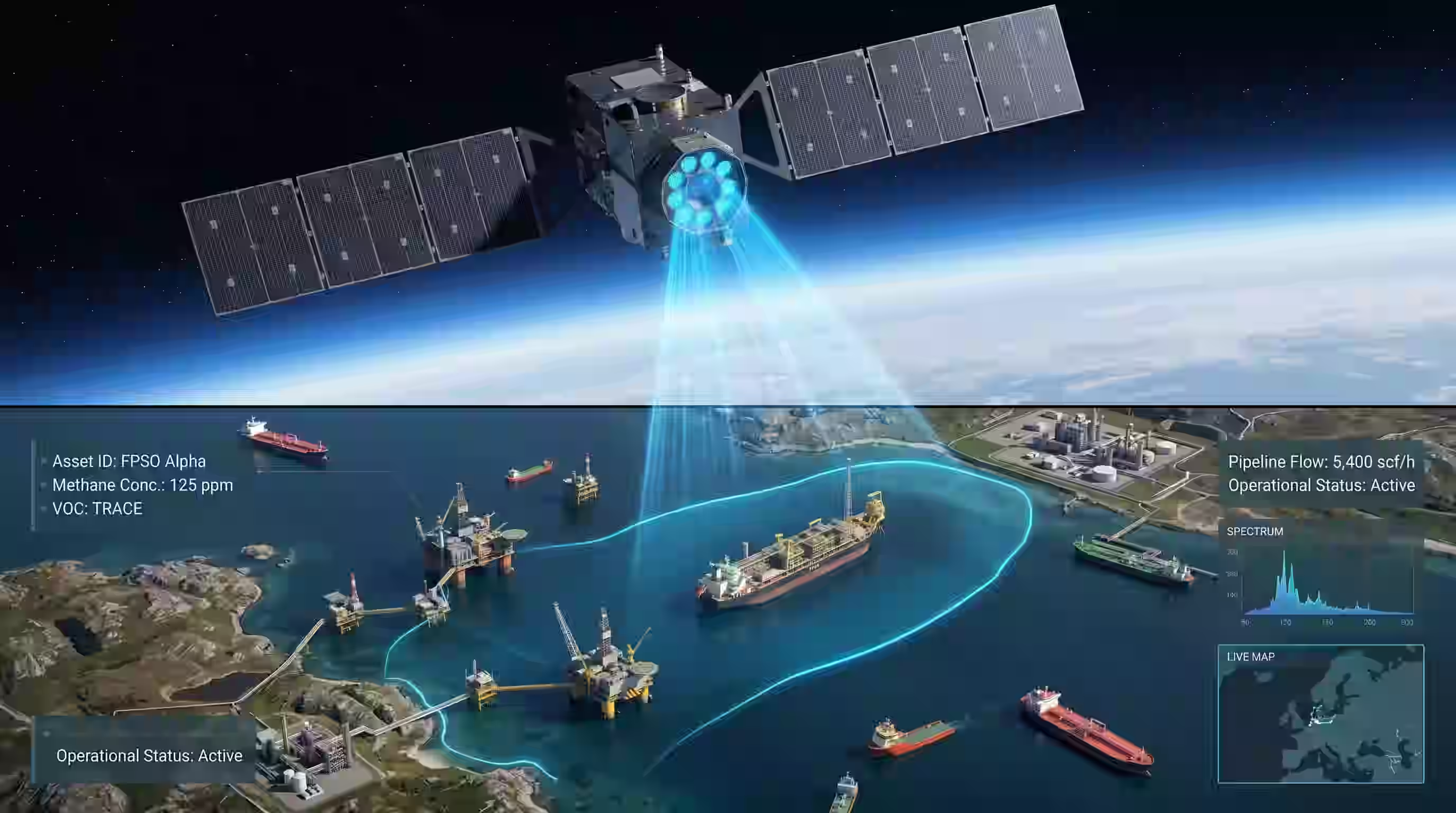
GHGSat now operates a constellation of 16 satellites with 25x25-metre pixel resolution, capable of detecting offshore plumes as small as 180 kg/h. Qube Technologies achieved 96.7% localisation accuracy in independent Colorado State University testing, with detection probability exceeding 90% within 15 minutes for releases above 5 kg/h. Caerus Oil and Gas has deployed Qube's continuous monitoring across 50+ sites in Colorado, targeting OGMP 2.0 Level 4 compliance. TotalEnergies has committed to continuous real-time detection on all operated upstream assets, having already achieved a 55% reduction in methane emissions versus 2020 - exceeding its 50% target a year early.
The reporting landscape is complex. The SEC Climate Disclosure Rule is functionally inoperative following the US court abeyance in September 2025. The EU CSRD's Omnibus simplification has raised thresholds and reduced mandatory data points by 61%, with Wave 2 and 3 reporting delayed by two years. However, ISSB standards (IFRS S1 and S2) have been adopted or finalised across 36 jurisdictions representing over 50% of global GDP. For global EMR operators, the question is not whether disclosure requirements will tighten but which framework will dominate in each operating jurisdiction. Compliance readiness in the energy sector increasingly requires technology-enabled monitoring, not periodic manual surveys.
How Far Has Autonomous Operations Progressed in Mining and Energy?
The global autonomous mining truck fleet reached approximately 3,832 units by mid-2025 - an 84% increase year-on-year - and is projected to reach 5,000 by 2030, according to GlobalData. Both Caterpillar (690 autonomous trucks, over 200 million autonomous miles) and Komatsu (900+ trucks, over 10 billion tonnes moved) report zero system-related lost-time injuries across their entire operational histories - a safety record that is fundamentally reframing the risk calculus for remote operations.
Rio Tinto operates the world's most integrated autonomous ecosystem from its Remote Operations Centre near Perth, where approximately 200 controllers manage 15 iron ore mines, four port terminals, and 1,700 kilometres of autonomous rail located 1,500 km away in the Pilbara. AutoHaul - the world's first fully autonomous heavy-haul railway - has logged over seven million autonomous kilometres, with an average speed increase of 5-6% and reported 12% productivity improvement over manned operations. Fortescue is transitioning to 360 autonomous Liebherr T 264 trucks as part of its $6.2 billion "Real Zero" programme, and is building a fully islanded green energy grid at city scale across its Pilbara operations - 290 MW of installed renewable capacity, 480+ km of high-voltage transmission, and proprietary energy management software targeting $2-4 per tonne iron ore cost reductions.
In inspection robotics, Gecko Robotics signed a $30 million multi-year contract with ADNOC Gas in 2025, where pilot deployment improved inspection efficiency by 93% versus manual methods. Shell completed the world's first fully robotic cargo oil tank special survey on the FPSO Turritella - zero human entry, zero diving - with ABS classification sign-off. Boston Dynamics' Spot handles approximately 70% of operator rounds at Imperial Oil's Cold Lake facility.
What these deployments have in common is that the technology did not replace governance - it created demand for more rigorous governance. Autonomous systems require precise operational boundaries, verified data handoff protocols, and independent assurance that reported performance metrics reflect actual outcomes rather than vendor dashboards. This is precisely the gap where project assurance distinct from project management becomes indispensable.
What Does This Mean for Boards and Executives?
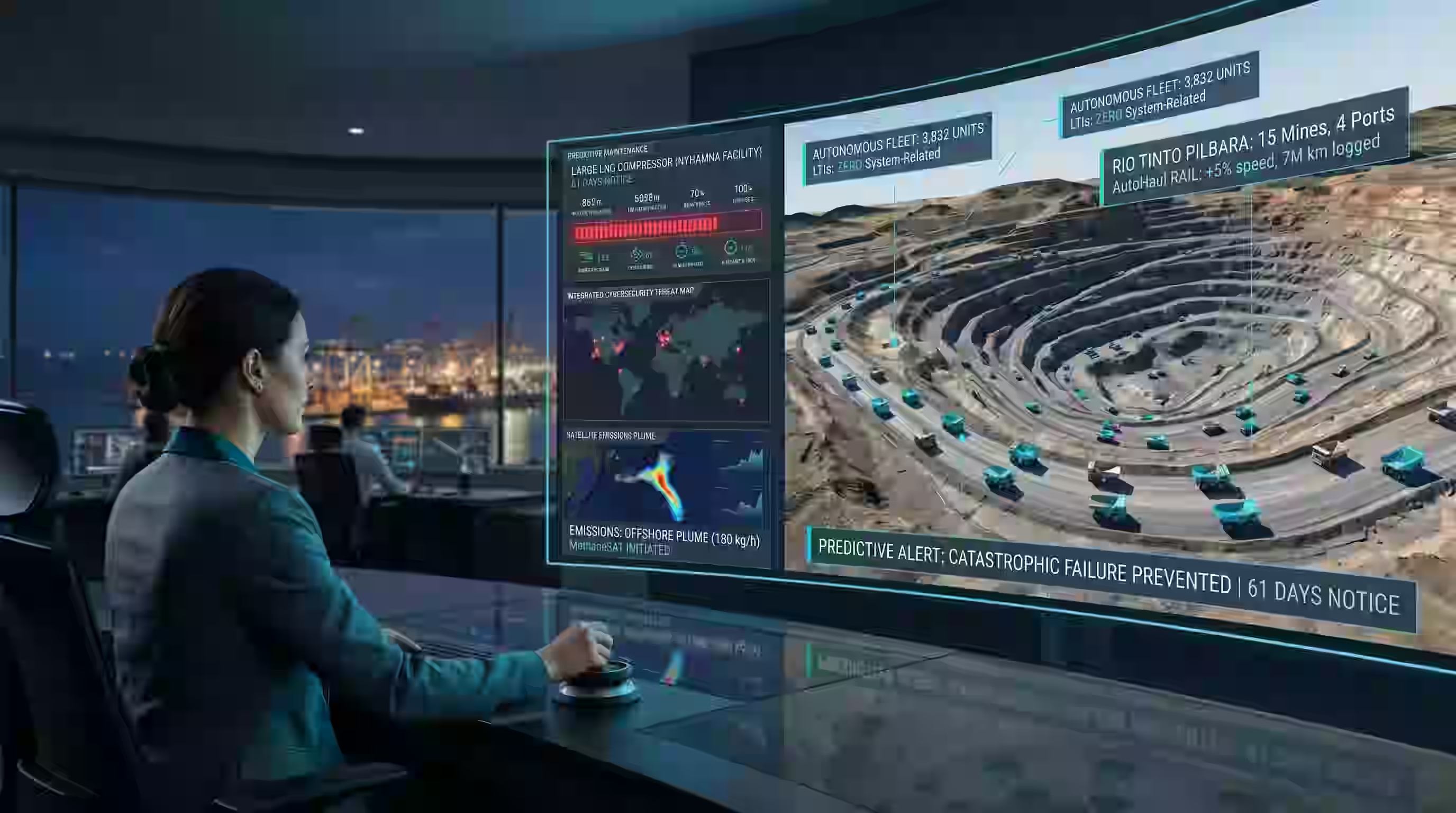
Three patterns emerge across all six categories. First, the ROI evidence base has matured. Digital twins generating $3 million in year-one savings, predictive maintenance preventing $40 million failures with 61 days' notice, and autonomous trucks achieving 12-30% productivity improvements with zero system-related injuries are documented across multiple operators and independent sources - not vendor claims.
Second, regulatory convergence is accelerating whether organisations are ready or not. EU NIS2 imposes personal liability on senior management for OT cyber failures. MethaneSAT's finding that actual emissions are 50% higher than inventory data will reshape compliance expectations globally. ISSB S1 and S2 are now mandated or finalised in 36 jurisdictions.
Third, the operators generating the most value are not simply deploying individual tools. Shell, Rio Tinto, TotalEnergies, and Fortescue are building integrated technology ecosystems where digital twin data feeds predictive maintenance models, autonomous systems report through remote operations centres, and emissions monitoring connects directly to regulatory workflows. The constraint is never the technology - it is the governance architecture required to make these systems verifiably productive at enterprise scale.
-----
PDAS provides independent assurance and governance for EMR capital projects and operations - verifying that technology investments deliver the outcomes reported, not just the outcomes promised. With 150+ years of combined practitioner experience across Shell, Rio Tinto, and TotalEnergies, our team implements the controls and verification frameworks required to close the gap between digital ambition and operational reality.


